







In Europe, GDPR does not ban call recording. It requires businesses to record and track calls lawfully, transparently, securely, and only for a defined purpose.
Call recording has become a core part of sales coaching, customer support, compliance, and dispute resolution. But in Europe, the question is not whether recording is useful. The real question is whether your business can justify it under GDPR and any country-level telecom or privacy rules that apply to the call.
This updated 2026 guide explains what businesses need to know before they record customer calls, what mistakes create the most legal risk, and how Salestrail fits into a privacy-conscious mobile call tracking workflow—especially for teams that rely on Android-based field sales and SIM-based calling.
Under GDPR, a call recording is usually personal data because it can contain a person’s voice, phone number, account details, complaints, financial discussions, or other identifiable information. That means recording, storing, replaying, sharing, and syncing calls into CRM systems all count as processing.
For most businesses, compliance comes down to five questions: Why are you recording? What legal basis are you relying on? Have you informed the caller clearly? Are you limiting access and retention? Can you prove your process if a regulator or customer asks?
That is why call tracking should never be treated as just a sales tool. In Europe, it is also a privacy and governance process.
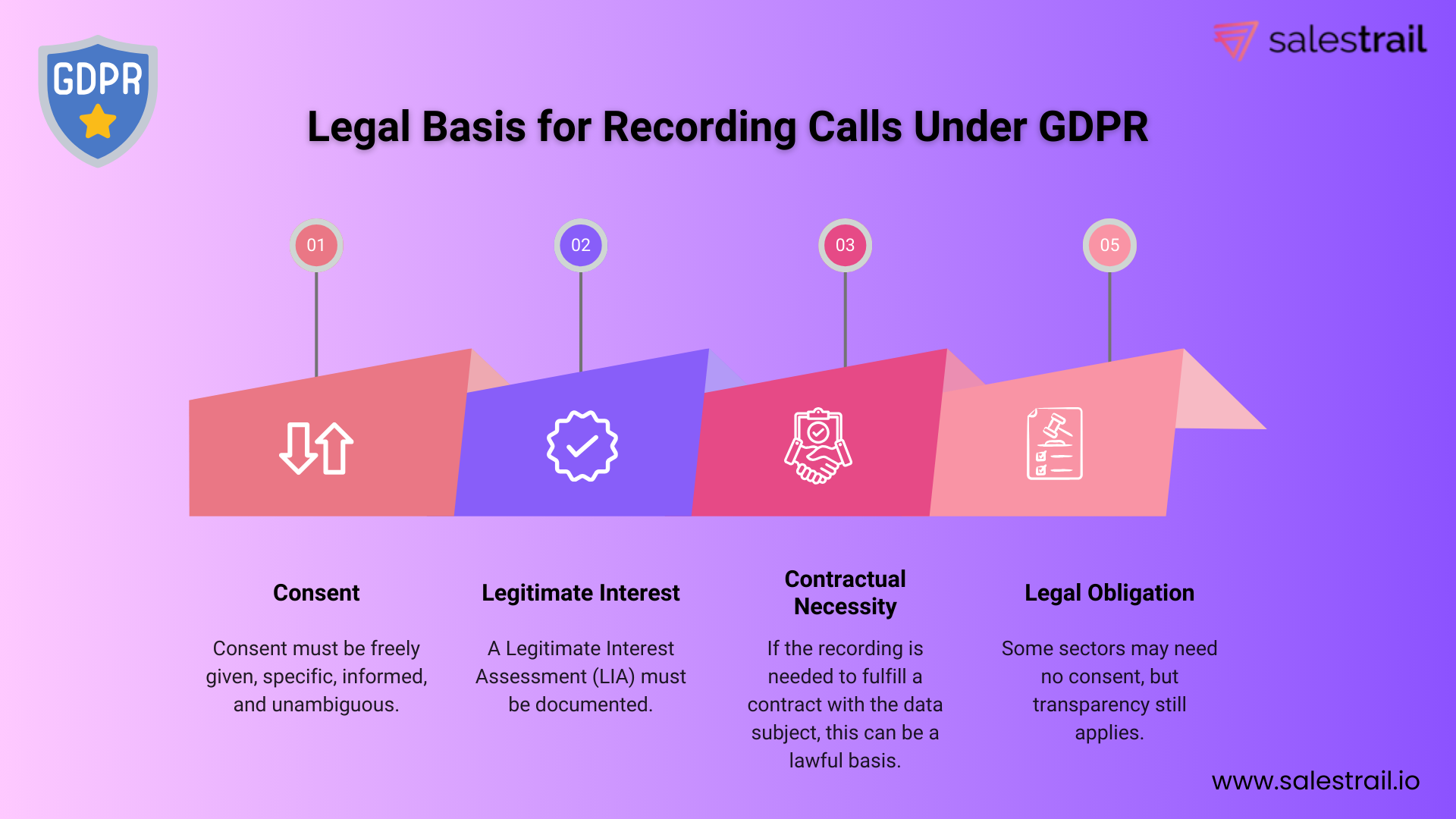
GDPR offers several legal bases, but for call recording these are the most relevant:
|
Legal basis |
When it may fit |
What businesses must still do |
|
Consent |
When the caller is given a real, informed choice and recording is not strictly necessary. |
Inform clearly before recording starts and offer a practical alternative where needed. |
|
Legitimate interest |
Often used for quality assurance, fraud prevention, training, and service improvement. |
Document a Legitimate Interest Assessment and confirm your interest does not override the person’s rights. |
|
Contractual necessity |
Where the recording is genuinely needed to perform or evidence a contract. |
Use this narrowly. Many businesses over-apply it where legitimate interest would be more realistic. |
|
Legal obligation |
Where a sector-specific rule requires recording, such as in regulated financial environments. |
Transparency and secure handling still apply even where consent does not. |
In practice, many businesses across Europe rely on legitimate interest rather than consent for routine business call recording. But that only works when the purpose is necessary, proportionate, documented, and transparently communicated.
GDPR applies across the EU, but businesses should not assume that every country treats recorded calls the same in practice. National telecom rules, employment rules, court expectations, and regulator guidance can affect how notice, consent, and business justification are interpreted. A practical 2026 planning approach is to apply a high standard across all markets and validate local rules before scaling.
|
Market |
Operational watchout for businesses |
|
Germany & Austria |
Expect a conservative compliance posture. Clear notice, strict internal controls, and careful justification are essential. |
|
France & Belgium |
Transparency and proportionality matter. If recordings are used for quality monitoring, policy wording and staff governance should be very clear. |
|
Spain & Italy |
Customer notice and purpose limitation should be prominent. Re-use of recordings beyond the original stated purpose can raise risk. |
|
Netherlands |
Keep privacy notices practical and readable. Regulators typically look for evidence that data handling is controlled, not just described. |
|
Poland, Czech Republic & Romania |
Do not assume lower enforcement risk means lower compliance risk. The same GDPR discipline should apply to storage, access, and retention. |
|
Pan-European sales teams |
Where a single rep calls multiple countries, standardize the disclosure, retention policy, and internal access model to the strictest workable baseline. |
This blog is informational and not legal advice. Businesses with regulated workflows or multi-country operations should validate country-specific requirements with counsel before recording customer calls at scale.
Salestrail is most useful when your team needs visibility into real mobile sales activity without forcing reps into a cloud telephony setup. Based on the available Salestrail product documentation, Android users can record SIM and WhatsApp calls, while recordings are securely uploaded to Salestrail cloud storage and governed through user access controls. On iOS, workflows are more limited and depend on platform constraints, so teams should align operational expectations by device.
From a GDPR perspective, the value is not that software makes compliance automatic. It is that the right setup can make compliance easier to operationalize. Secure storage, controlled access to recordings, searchable logs, and CRM-linked workflows help businesses keep call data organized and avoid the chaos that often creates privacy risk.
For Europe-based sales teams, that matters most when mobile calling is part of day-to-day selling and managers need lawful visibility into business conversations, coaching, and follow-up activity.
Yes—if you have a valid legal basis, inform the caller appropriately, and manage recordings in line with GDPR principles such as purpose limitation, data minimization, storage limitation, and security.
No. Many businesses rely on legitimate interest or legal obligation instead of consent. But that decision must be documented and defensible.
Usually yes. A voice recording linked to a person, number, account, or discussion is typically personal data under GDPR.
Often yes, but only when the purpose is clearly defined, disclosed, proportionate, and supported by the right legal basis.
Recording without clear notice is one of the most common and highest-risk mistakes. Close behind it are poor retention controls and weak access governance.
Only for as long as they genuinely need them for the stated purpose or a legal requirement. A written retention rule is far safer than open-ended storage.
Yes. If call data or recording links are pushed into a CRM, that is still personal data processing and must match your stated purpose and access model.
Salestrail can support compliant mobile call operations by centralizing business call visibility, secure storage, and controlled access—especially for Android teams recording SIM and WhatsApp calls as part of a documented privacy process.
The businesses that handle call recording best in 2026 are not the ones recording the most calls. They are the ones with the clearest purpose, the cleanest process, and the strongest controls.
If your team sells across Europe, the safest approach is simple: define the legal basis, disclose recording clearly, limit access, set retention rules, and use a tool that fits how your reps actually call customers on mobile.






No Comments Yet
Let us know what you think